
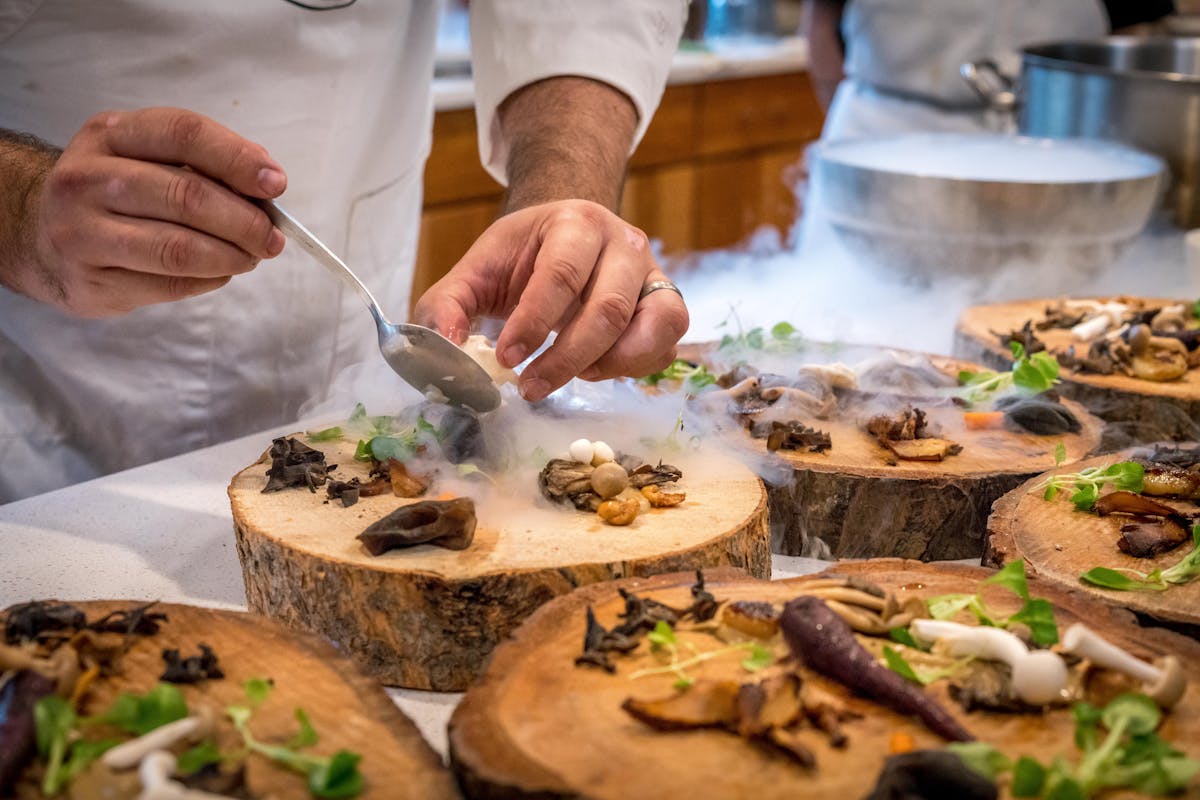
Photo: Life Of Pix via Pexels
Texas restaurant SBA lending is the standout growth story in the national data — +42.6% YoY growth, roughly five times the national restaurant rate. Texas is the second-largest restaurant SBA market in the US and deals run notably larger than even California, reflecting the state’s major-metro buildout and acquisition pipeline.
Answer 4 questions. Get matched with Texas-restaurant-experienced SBA lenders.
Skip to Texas stats →See the national picture at the SBA restaurants guide.
SBA 7(a) loans to restaurants operators in Texas, fiscal years 2020 through December 2025. Pulled from SBA FOIA 7(a) dataset.
Texas leads the next-largest state (CA) by roughly 0.58× on SBA restaurants loan count — the concentration is real, not noise. Top 8 states account for about half of all national restaurants SBA volume.
The ten banks that have approved the most SBA 7(a) loans to restaurants operators in Texas FY2020-2025. Pulled directly from SBA FOIA data. Loan count alone doesn’t capture fit for your specific deal — volume leaders and specialist fit can differ.
Texas’s restaurant SBA lender mix is distinctive in two ways. First, The Huntington National Bank dominates at the top with 102 Texas restaurant SBA loans — nearly 2.3x the next lender. Huntington is the national restaurant SBA volume leader, and its Texas presence reflects a deliberate specialty-lending strategy more than a traditional branch footprint. Second, three Korean-American community banks (PCB Bank, Bank of Hope, Hanmi Bank) each appear in the top five, collectively accounting for roughly 10% of Texas restaurant SBA volume. The pattern mirrors California’s lender mix and reflects the Korean-American restaurant operator network in Houston and DFW.
Two Texas-headquartered regional banks complete the picture: Cadence Bank (Dallas-based, 30 loans) and Frost Bank (San Antonio-based, 26 loans). Cadence and Frost both carry strong in-market restaurant SBA relationships particularly for larger acquisition and real-estate-combined deals in the $500K–$2M range. PNC Bank and Newtek round out the top ten alongside Northeast Bank and Readycap. The takeaway: Texas has more viable lender paths than most single-state markets — specialist national platforms (Huntington, Newtek, Readycap), Korean-American community banks (PCB, Hope, Hanmi), and Texas regionals (Cadence, Frost). Matching to the right one for your specific deal profile is the practical variable that matters most.
Texas is the single fastest-growing restaurant SBA market in the United States. TX restaurant SBA lending grew +42.6% year-over-year, compared to the national restaurant rate of +8.7%. The growth is broad-based rather than concentrated in one metro — Houston, Dallas-Fort Worth, Austin, and San Antonio each carry meaningful independent volume, and the state’s population growth and commercial real estate expansion continue to pull both independent and franchise restaurant capital into the SBA channel.
Texas is now the second-largest single-state restaurant SBA market at 7.3% of national volume — 1,192 loans approved FY2020-2025 representing $879.6 million in total approved capital. Only California is larger. And Texas deals run meaningfully bigger than even California’s: $738,000 average vs. $603,000 in California and $528,000 nationally. Median loan in Texas is $461,000, roughly 81% above the national median of $255,000, reflecting both the scale of DFW and Houston acquisitions and a tilt toward full-service concepts over small quick-service operators.
Four major metros dominate Texas restaurant SBA volume: Dallas-Fort Worth, Houston, Austin, and San Antonio. DFW and Houston carry the highest absolute volume reflecting population and dining-out scale. Austin punches above its population weight driven by both the tech-employment-driven demand base and a dense independent-restaurant culture. San Antonio runs a more franchise-heavy mix than the other three metros. Secondary markets including El Paso, Corpus Christi, and the Rio Grande Valley add meaningful volume, and Texas’s mid-sized metros (Plano, Arlington, Waco, Lubbock) have active SBA restaurant lending relative to their size.
Texas restaurant SBA 7(a) loans charge off at 1.26% — a 0.93× ratio against the all-industry SBA average of 1.36%. That’s modestly above the national restaurant rate of 1.21% but still materially better than the cross-industry SBA baseline, which is unusual for a restaurant cohort. The favorable performance reflects Texas’s lower structural cost baseline (no state income tax, federal minimum wage of $7.25 applies statewide, commercial rent pressures lower than California) combined with a borrower base that leans toward experienced operators on larger-ticket deals.
Texas is a meaningfully friendlier regulatory environment than California for restaurant SBA underwriting. The items that routinely come up:
The regulatory friendliness is real but not a substitute for deal quality — lenders still underwrite the operator, the concept, the unit economics, and the location. What Texas provides is a cost baseline that makes marginal files more underwritable than equivalent California files.
Major Texas metros where our partner lenders actively run SBA deals. These pages cover broader small-business lending context for each market.
SBA 7(a) is the dominant path for restaurants acquisitions, buildouts, equipment, and working capital. Standard 7(a) goes up to $5 million; 7(a) Small Loan streamlines deals under $500K. SBA 504 handles real estate and heavy fixed-asset purchases when the deal includes the property. Minimum 10% equity injection applies; specialist lenders typically want 15-20% on Texas restaurants deals given the higher cost structure. Up to 5% of equity can come from seller financing on full-standby terms.
For the full SBA restaurants lending guide — including program details, independent vs. franchise dynamics, the restaurants charge-off context, and the complete national picture — see our SBA restaurants loan guide. This state page focuses on the Texas-specific data and market context on top of that national foundation.
Texas restaurants SBA is a specialist segment. The top Texas lenders understand the state's cost structure, labor economics, and regulatory context that generalist banks routinely miss. See the broader SBA restaurants guide or SBA loans hub.
Match with Texas SBA lenders →MMM does not originate SBA loans. Applications are processed through SBA-authorized lenders. Statistics above are sourced from the SBA FOIA 7(a) dataset, fiscal years 2020 through December 2025.