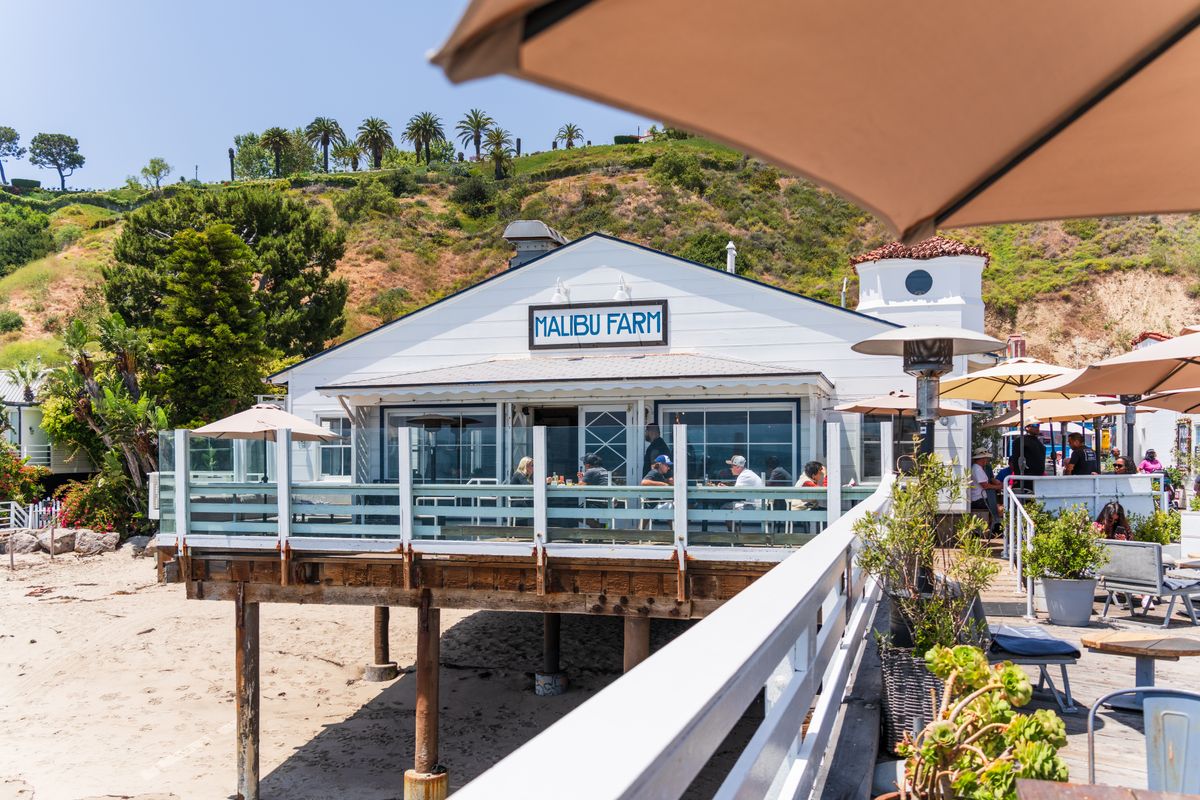
Coastal California restaurant dining patio — Malibu Farm Pier Cafe with ocean view, representative of California restaurants that use SBA financing

Photo: Abhishek Navlakha via Pexels

SBA Loans for Restaurants in California

California is the largest restaurant SBA lending market in the United States — 12.6% of all restaurant SBA loans nationally. Deal sizes run larger than the national average, the lender mix has unique California characteristics, and regulatory context meaningfully affects underwriting.

Answer 4 questions. Get matched with California-restaurant-experienced SBA lenders.

Skip to California stats →
Question 1 of 4

What's your California restaurant situation?

California restaurants SBA lending — by the numbers

SBA 7(a) loans to restaurants operators in California, fiscal years 2020 through December 2025. Pulled from SBA FOIA 7(a) dataset.

Share of national restaurants SBA
12.6%
Largest single-state restaurants SBA market
Loans approved
2,062
FY2020-2025 in California
Total approved
$1.24B
Combined California volume
Average loan size
$603K
+14.3% vs national avg $528K
California charge-off rate
1.45%
vs 1.21% national restaurants / 1.36% SBA avg
YoY growth in California
+8.2%
vs +8.7% national restaurants

California vs national — at a glance

+14.3%
Average loan size
$603K California  vs  $528K national
Higher average reflects California real estate and buildout costs relative to national baseline.
+0.24pp
Charge-off rate
1.45% California  vs  1.21% national restaurants
Modestly above national restaurants; California cost structure pressures margins.
12.6%
Of all US restaurants SBA loans
California is the largest single-state restaurants SBA market in the US.

How California compares to other top restaurants states

California leads the next-largest state (TX) by roughly 1.73× on SBA restaurants loan count — the concentration is real, not noise. Top 8 states account for about half of all national restaurants SBA volume.

Top 8 states for SBA restaurants loans, CA highlighted Horizontal bar chart of the top 8 states by SBA restaurants loan count: CA 2,062 loans (12.6%); TX 1,192 loans (7.3%); NY 1,057 loans (6.5%); FL 975 loans (6.0%); OH 856 loans (5.2%); IL 696 loans (4.3%); MI 621 loans (3.8%); GA 612 loans (3.7%). CA highlighted in green; other states in gray. CA 2,062 • 12.6% TX 1,192 • 7.3% NY 1,057 • 6.5% FL 975 • 6.0% OH 856 • 5.2% IL 696 • 4.3% MI 621 • 3.8% GA 612 • 3.7%

Top SBA lenders for California restaurants

The ten banks that have approved the most SBA 7(a) loans to restaurants operators in California FY2020-2025. Pulled directly from SBA FOIA data. Loan count alone doesn’t capture fit for your specific deal — volume leaders and specialist fit can differ.

Top 10 SBA restaurants lenders in California by loan count Horizontal bar chart: Bank of Hope 211 loans; U.S. Bank, National Association 198 loans; Northeast Bank 91 loans; Readycap Lending, LLC 74 loans; Hanmi Bank 62 loans; Newtek Bank, National Association 56 loans; PCB Bank 55 loans; Lendistry SBLC, LLC 55 loans; Celtic Bank Corporation 54 loans; Bank of America, National Association 54 loans. Korean-American community banks (Bank of Hope, Hanmi Bank, PCB Bank) highlighted in amber; all other lenders in blue. Bank of Hope 211 U.S. Bank, N.A. 198 Northeast Bank 91 Readycap Lending, LLC 74 Hanmi Bank 62 Newtek Bank, N.A. 56 PCB Bank 55 Lendistry SBLC, LLC 55 Celtic Bank 54 Bank of America, N.A. 54

California’s restaurant SBA lender mix has a distinctive feature: three Korean-American community banks appear in the top ten — Bank of Hope (the #1 lender by count), Hanmi Bank (#5), and PCB Bank (#7). Combined, these three institutions account for roughly 16% of all California restaurant SBA lending in the dataset.

The pattern reflects genuine market dynamics. Korean-American restaurant ownership is a significant segment of California’s independent restaurant industry, particularly in Los Angeles, Orange County, and the Bay Area. These community banks were built to serve that customer base and carry deep lending relationships with Korean-American restaurant operators across multiple generations. For buyers outside that network, the lender landscape still includes strong non-community-bank options — U.S. Bank (#2 in CA), Northeast Bank, Readycap, Newtek, and Bank of America all appear in the top ten. For buyers who are part of the Korean-American restaurant operator network, Bank of Hope, Hanmi, and PCB are well worth direct approach alongside a broader lender-matching search.

California restaurants market context

California is the largest restaurant market in the United States by almost any measure — population, restaurant count, dining-out spend, tourism-driven demand. That scale shows up in the SBA data: California accounts for 12.6% of all restaurant SBA loans nationally, with 2,062 loans approved FY2020-2025 and $1.24 billion in total approved volume. The second-largest restaurant SBA state (Texas) trails California at 7.3% share.

California’s restaurant SBA deals also run larger than the national average: $603,000 average loan vs. $528,000 nationally (+14%), with the median loan at $315,000 vs. $255,000 nationally (+24%). The higher deal sizes reflect California’s commercial real estate costs, labor cost structure, and tendency toward more capital-intensive concepts compared to lower-cost states.

Major metros drive the concentration

Los Angeles, San Francisco / Bay Area, and San Diego are the three dominant metros for California restaurant SBA lending. Orange County, Sacramento, and the Inland Empire each add meaningful volume. San Jose and the broader Silicon Valley area skew toward higher-ticket full-service concepts, while LA and SF carry the full range from neighborhood independents to high-capital acquisitions.

California regulatory context for SBA underwriting

Several California-specific factors meaningfully affect how lenders underwrite restaurant deals in the state:

None of this is disqualifying — specialist California restaurant lenders underwrite to these conditions every day. What it does mean is that lender match matters even more in California than in lower-cost states.

Restaurant SBA mechanics — the short version

SBA 7(a) is the dominant path for restaurants acquisitions, buildouts, equipment, and working capital. Standard 7(a) goes up to $5 million; 7(a) Small Loan streamlines deals under $500K. SBA 504 handles real estate and heavy fixed-asset purchases when the deal includes the property. Minimum 10% equity injection applies; specialist lenders typically want 15-20% on California restaurants deals given the higher cost structure. Up to 5% of equity can come from seller financing on full-standby terms.

For the full SBA restaurants lending guide — including program details, independent vs. franchise dynamics, the restaurants charge-off context, and the complete national picture — see our SBA restaurants loan guide. This state page focuses on the California-specific data and market context on top of that national foundation.

Frequently Asked Questions

Can I get an SBA loan for a restaurant in California?
Yes. California is the largest single-state restaurant SBA lending market in the US — 2,062 loans approved FY2020-2025 representing 12.6% of all national restaurant SBA volume. SBA 7(a) covers acquisitions, buildouts, equipment, and working capital. Minimum 10% equity injection applies, with specialist lenders typically wanting 15-20% on California deals given the higher cost structure.
What's the typical SBA restaurant loan size in California?
Average SBA restaurant loan in California is approximately $603,000 — roughly 14% above the national restaurant average of $528,000. Median is $315,000 vs. $255,000 nationally. The higher deal sizes reflect California commercial real estate costs, buildout costs, and the tendency toward more capital-intensive concepts particularly in major metros.
Do California restaurants have a higher charge-off rate than national averages?
Modestly, yes. California restaurant SBA 7(a) charge-offs run at 1.45%, compared to the national restaurant average of 1.21% and the all-industry SBA average of 1.36%. The difference reflects California's higher operating cost baseline (labor, rent, compliance) which compresses margins compared to lower-cost states. California restaurants with strong unit economics and experienced operators still underwrite favorably; the state-level average is not a per-file verdict.
Which SBA lenders are most active in California restaurant lending?
Bank of Hope leads by loan count (211 CA restaurant loans), followed by U.S. Bank (198), Northeast Bank (91), Readycap Lending (74), Hanmi Bank (62), Newtek Bank (56), and PCB Bank (55). The top 10 is meaningfully different from the national top 10 — three Korean-American community banks (Bank of Hope, Hanmi, PCB) appear in the California top 10 and collectively represent a significant share of CA restaurant SBA volume.
How does California's minimum wage affect SBA restaurant underwriting?
Lenders model California's labor cost baseline explicitly in post-close cash flow projections rather than applying national benchmarks. California minimum wage ($16.50 statewide, $20 for fast food, higher in many cities) drives labor as a percentage of revenue above national averages. Specialist California restaurant lenders account for this automatically; generalist banks unfamiliar with California labor economics sometimes over-project margins and under-structure working capital.
How long does an SBA loan take to close for a California restaurant?
60-90 days is typical for a SBA 7(a) acquisition or buildout deal with a Preferred Lender experienced in California restaurants. Deals involving California ABC liquor license transfers can add 60-120 days depending on license type and county — lenders experienced with California deals coordinate with the ABC process explicitly. Generalist banks unfamiliar with California ABC liquor license complexity routinely extend timelines meaningfully.
What California-specific issues should I expect in SBA underwriting?
Four factors routinely come up: labor cost modeling (California wage structure), PAGA and wage-and-hour compliance history (clean history underwrites better), liquor license transfer timing and complexity, and rent-to-sales ratios (California commercial rent pressures push rents above national benchmarks). Specialist California restaurant lenders handle these as standard practice; matching to an experienced lender materially affects both timeline and pricing.

Get matched with California restaurant SBA lenders

California restaurants SBA is a specialist segment. The top California lenders understand the state's cost structure, labor economics, and regulatory context that generalist banks routinely miss. See the broader SBA restaurants guide or SBA loans hub.

Match with California SBA lenders →

MMM does not originate SBA loans. Applications are processed through SBA-authorized lenders. Statistics above are sourced from the SBA FOIA 7(a) dataset, fiscal years 2020 through December 2025.