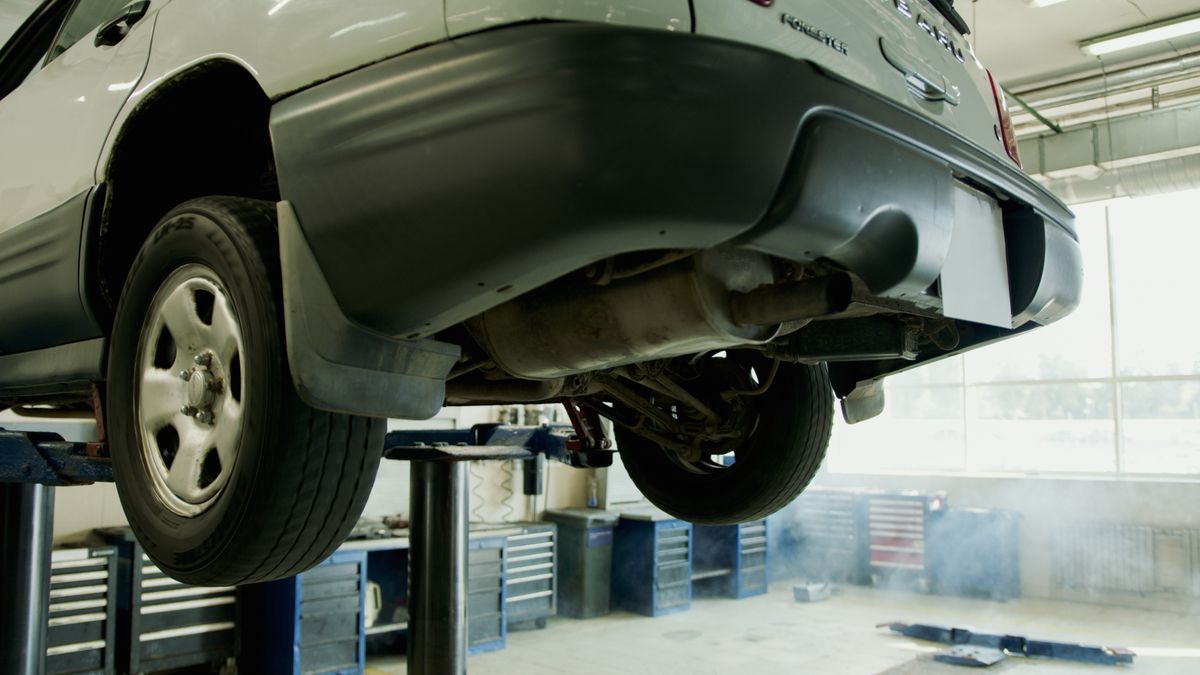
Photo: Artem Podrez via Pexels
SBA 7(a) is the dominant financing path for auto repair shop acquisitions, equipment upgrades, and real estate. The sector’s +27% YoY SBA lending growth reflects a real consolidation and reinvestment cycle. Here’s how lenders actually evaluate these files.
Answer 6 questions. Get matched with auto-repair-experienced SBA lenders.
Skip to program details →New to SBA? Start with SBA loan requirements.
SBA 7(a) loans to general automotive repair (NAICS 811111), fiscal years 2020 through December 2025. Pulled from SBA FOIA 7(a) dataset.
SBA 7(a) handles most auto repair acquisitions and expansion needs. SBA 504 adds long-term fixed rates when real estate is part of the deal. Equipment financing is the non-SBA alternative for speed.
Right for: shop acquisitions, fleet expansion, real estate combined with the operating business.
Right for: buying the shop real estate. Fixed long-term rates on the real-estate portion; paired with 7(a) companion loan for the business.
Right for: lift replacement, diagnostic tool upgrades, working capital under $500K.
Right for: lifts, alignment racks, diagnostic equipment. 3-10 day funding vs. 45-75 for SBA — speed often matters more than rate on single-piece equipment.
Auto repair SBA underwriting looks more favorable than most equipment-heavy service industries because the assets are collateral-strong and the demand is non-discretionary. Unlike restaurants, auto repair shops don’t live or die by concept — repeat customers, insurance-paid collision work, and steady maintenance cycles create predictable revenue streams. The charge-off rate on SBA auto repair loans reflects that underlying stability.
Auto repair acquisitions routinely include $150K to $400K in specialized equipment — two-post and four-post lifts ($4K-$15K each), alignment racks ($20K-$60K), diagnostic equipment including OEM scan tools ($5K-$50K each for dealer-level capability), tire machines, A/C recovery systems, brake lathes, and welding equipment. Lenders get an itemized equipment list with model year and condition because equipment value backs the loan directly.
Lenders want to see the split across general repair, insurance / collision work, fleet contracts, and state-inspection revenue. A shop with a diversified revenue stack and documented recurring fleet accounts underwrites meaningfully better than a shop leaning heavily on one channel. Insurance-paid collision revenue in particular is a stability signal because claim flow correlates with accident rates rather than consumer discretionary spend.
A meaningful share of auto repair SBA deals include the real estate. That shifts the deal structure toward SBA 504 for the property plus 7(a) companion for the operating business, or a combined 7(a) covering both. Real estate ownership stabilizes the long-term economics — auto repair is zoning-sensitive and municipalities increasingly restrict where shops can operate, so owning the site materially protects against forced relocation.
Lenders weight shop management experience heavily. An ASE-certified master tech with GM experience buying an existing shop underwrites better than a non-technical operator buying the same shop and hiring a manager. Not disqualifying, but inexperienced operators typically see higher equity injection expectations or a requirement for a documented management agreement with an experienced shop lead.
Franchise-operator loans account for roughly 7.46% of auto repair SBA volume — meaningfully less franchise-heavy than restaurants. The industry leans independent. Common franchise brands in the SBA data are tire-and-service chains, quick-lube operators, and collision-repair franchises. When the franchise is listed in the SBA Franchise Directory, most brand-level underwriting is already complete and lenders focus on the operator and site.
Independent shops take the full underwriting path: operator experience, existing shop financials if acquisition, equipment appraisal, location and real estate (if included). Independent auto repair files close routinely because the equipment and operator pattern is well-understood by specialist lenders.
Auto repair charge-offs run at 1.00%%, compared to the all-industry SBA average of 1.36%% — a 0.73x ratio. The better-than-average performance reflects three structural features of the industry: non-discretionary demand (cars need to run), collateral-strong equipment (lifts, diagnostic tools, compressors retain recoverable value if the loan fails), and multi-channel revenue (retail customers, insurance claims, fleet, inspection) that cushions any single-channel downturn.
The +27% YoY growth in SBA lending to auto repair shops reflects real market dynamics, not just SBA-specific expansion. An aging baby-boomer operator cohort is selling practices to younger operators who need financing for the transition. Corporate consolidators — both PE-backed and strategic — are competing with individual buyers, which both pushes valuations up and creates more SBA-financed alternatives for sellers who want a non-corporate exit.
What this means for a borrower: lenders experienced with auto repair deals recognize the favorable underwriting profile and move quickly. Generalist banks sometimes miss the equipment-collateral mechanics entirely and price or structure these deals sub-optimally. Specialist lender match is the biggest practical variable.
The ten banks that have approved the most SBA 7(a) auto repair loans FY2020-2025. Pulled directly from SBA FOIA data. Loan count alone doesn’t capture lender fit for your specific deal — volume leaders and specialist fit can differ.
Top 10 lenders account for approximately 42.2% of all auto repair SBA 7(a) volume.
The eight states leading in auto repair SBA 7(a) approvals FY2020-2025. CA leads the next-largest state (TX) by roughly 1.54× on loan count; top 8 states account for roughly half of all national auto repair SBA volume.
Texas is the fastest-growing auto repair SBA state (+52% YoY, nearly 2x the national auto-repair rate) and #2 by volume. More state-specific auto repair SBA guides will appear here as volume justifies the depth.
Adjacent SBA lending pages with shared underwriting mechanics or audience overlap for auto repair borrowers.
Auto repair SBA is a narrow specialty. The top ten lenders above handle a meaningful share of all auto repair 7(a) volume — matching there vs. a generalist branch is the difference between a clean 60-day close and a stalled file. See the broader SBA loans hub or SBA acquisition mechanics.
Match with auto repair SBA lenders →MMM does not originate SBA loans. Applications are processed through SBA-authorized lenders. Statistics above are sourced from the SBA FOIA 7(a) dataset, fiscal years 2020 through December 2025.